EXPLORING ACTIVE LEARNING IN MENTAL HEALTH
Headspace

EXPLORING ACTIVE LEARNING IN MENTAL HEALTH
Headspace
EXPLORING ACTIVE LEARNING IN MENTAL HEALTH
Headspace
In this independent design exploration, I challenged myself to think beyond UX into brand and strategy, exploring where Headspace could evolve next. Building upon its positioning as a reliable tool for well-rounded mental health education, I designed interactive practice modules to encourage active skill-building that goes beyond passive consumption.
Note: work not affiliated with Headspace; the company's public brand guidelines are applied
DURATION
6 weeks
ROLE
Product designer (solo)
SKILLS
UI/UX, market research, branding
TOOLS
Figma
CONTEXT
Digital mental health tools are largely passive, but mental health requires active learning
Digital mental health tools are largely passive, but mental health requires active learning
Digital mental health tools have become widely accessible, but much of the current market is built around passive learning: short videos, advice, and one-off moments of relief. While these experiences can be helpful, they often stop at awareness.
Mental health skills are active and relational. Without opportunities to actively practice what they’re learning, people may understand concepts without knowing how to apply them when it matters. The gap between learning and practicing became my starting point for this project.
Digital mental health tools have become widely accessible, but much of the current market is built around passive learning: short videos, advice, and one-off moments of relief. While these experiences can be helpful, they often stop at awareness.
Mental health skills are active and relational. Without opportunities to actively practice what they’re learning, people may understand concepts without knowing how to apply them when it matters. The gap between learning and practicing became my starting point for this project.
JUMP TO SOLUTION
WHY HEADSPACE
Headspace is already positioned as a place for daily mental health care
The platform has helped make mental health more approachable, and it's increasingly positioned as a trusted place for learning and support. While many digital mental health tools focus on symptom relief, Headspace is paving the way toward proactive mental health support, expanding beyond meditation into broader mental health education.
WHY HEADSPACE
Headspace is already positioned as a place for daily mental health care
The platform has helped make mental health more approachable, and it's increasingly positioned as a trusted place for learning and support. While many digital mental health tools focus on symptom relief, Headspace is paving the way toward proactive mental health support, expanding beyond meditation into broader mental health education.
WHY HEADSPACE
Headspace is already positioned as a place for daily mental health care
The platform has helped make mental health more approachable, and it's increasingly positioned as a trusted place for learning and support. While many digital mental health tools focus on symptom relief, Headspace is paving the way toward proactive mental health support, expanding beyond meditation into broader mental health education.
Why this mattered to me
Why this mattered to me
As a designer interested in mental health education and behavior change, I was curious where Headspace could evolve next, building upon its trusted platform to help people move from learning about skills to practicing and applying them.
As a designer interested in mental health education and behavior change, I was curious where Headspace could evolve next, building upon its trusted platform to help people move from learning about skills to practicing and applying them.
OPPORTUNITY
From a passive, exploratory experience to an active, guided one
From a passive, exploratory experience to an active, guided one
While Headspace excels at introducing concepts in an approachable way, much of the experience is built around tradeoffs that shape how members learn over time. While these choices have helped Headspace scale, at the same time, I see a meaningful opportunity to build on its strengths:
While Headspace excels at introducing concepts in an approachable way, much of the experience is built around tradeoffs that shape how members learn over time. While these choices have helped Headspace scale, at the same time, I see a meaningful opportunity to build on its strengths:
HEADSPACE TODAY
HEADSPACE TODAY
REIMAGINED
REIMAGINED
Passive
Passive
Building awareness of skills, not practicing them
Building awareness of skills, not practicing them
Active
Active
Interactive, skill-based learning focused on real-world scenarios
Interactive, skill-based learning focused on real-world scenarios
Exploratory
Exploratory
Requiring members to self-direct when they may be overwhelmed
Requiring members to self-direct when they may be overwhelmed
Guided
Guided
Gentle nudges and scaffolded learning without removing autonomy
Gentle nudges and scaffolded learning without removing autonomy
Individual
Individual
Solo engagement despite mental health being deeply relational
Solo engagement despite mental health being deeply relational
Collective
Collective
Long-term
Long-term
Skill-building in shared spaces to extend impact beyond the screen
Skill-building in shared spaces to extend impact beyond the screen
REIGNITING THE MISSION
How might Headspace evolve from a place of learning into a place of active skill-building, while staying approachable and compassionate at scale?
How might Headspace evolve from a place of learning into a place of active skill-building, while staying approachable and compassionate at scale?
SOLUTION
An active, guided approach to mental health skill-building
An active, guided approach to mental health skill-building
Practice Paths are guided, interactive learning programs that help members actively build mental health skills over time. Rather than browsing standalone content, members follow scaffolded learning journeys focused on specific skills.
Practice Paths are guided, interactive learning programs that help members actively build mental health skills over time. Rather than browsing standalone content, members follow scaffolded learning journeys focused on specific skills.
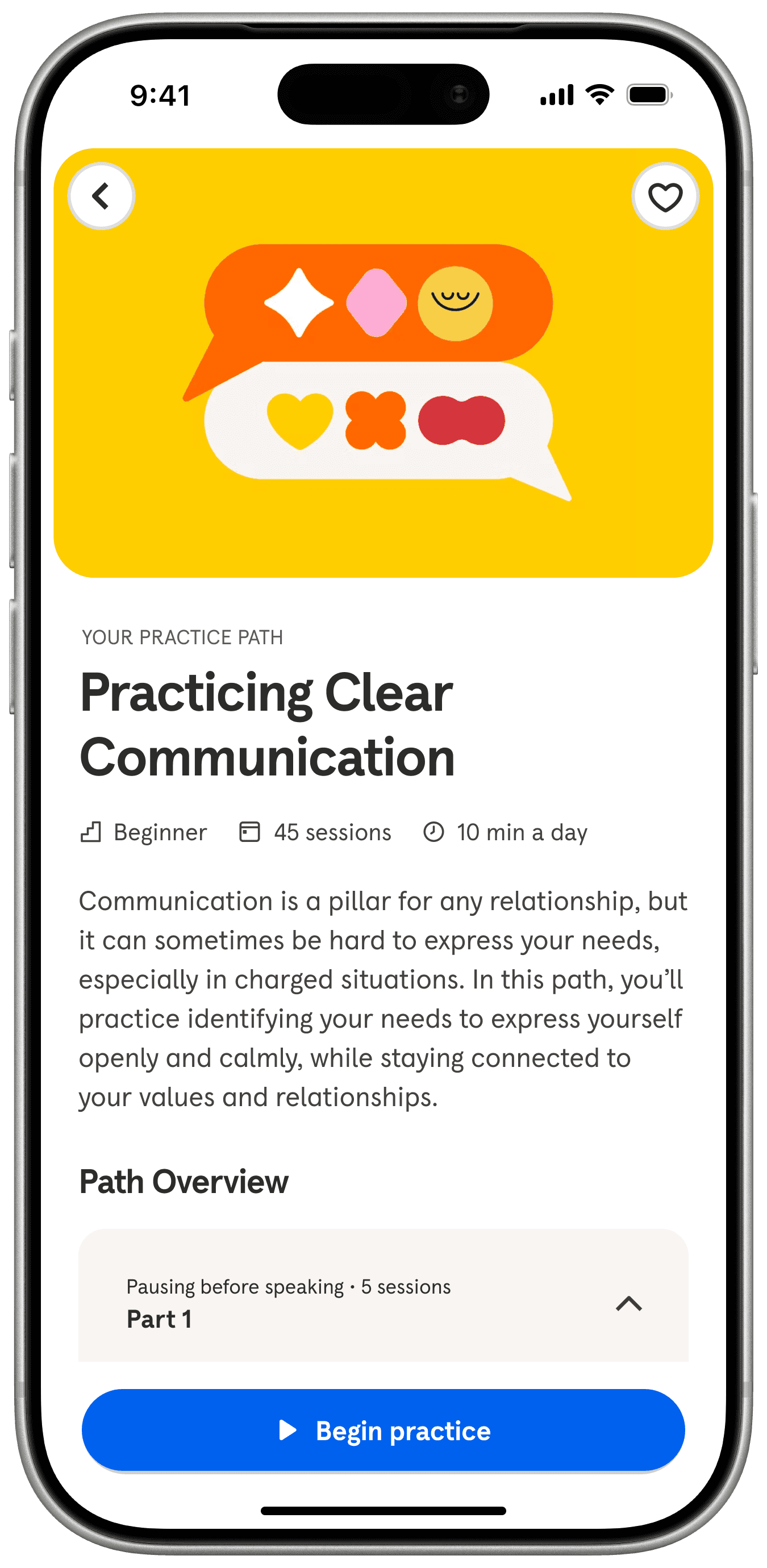

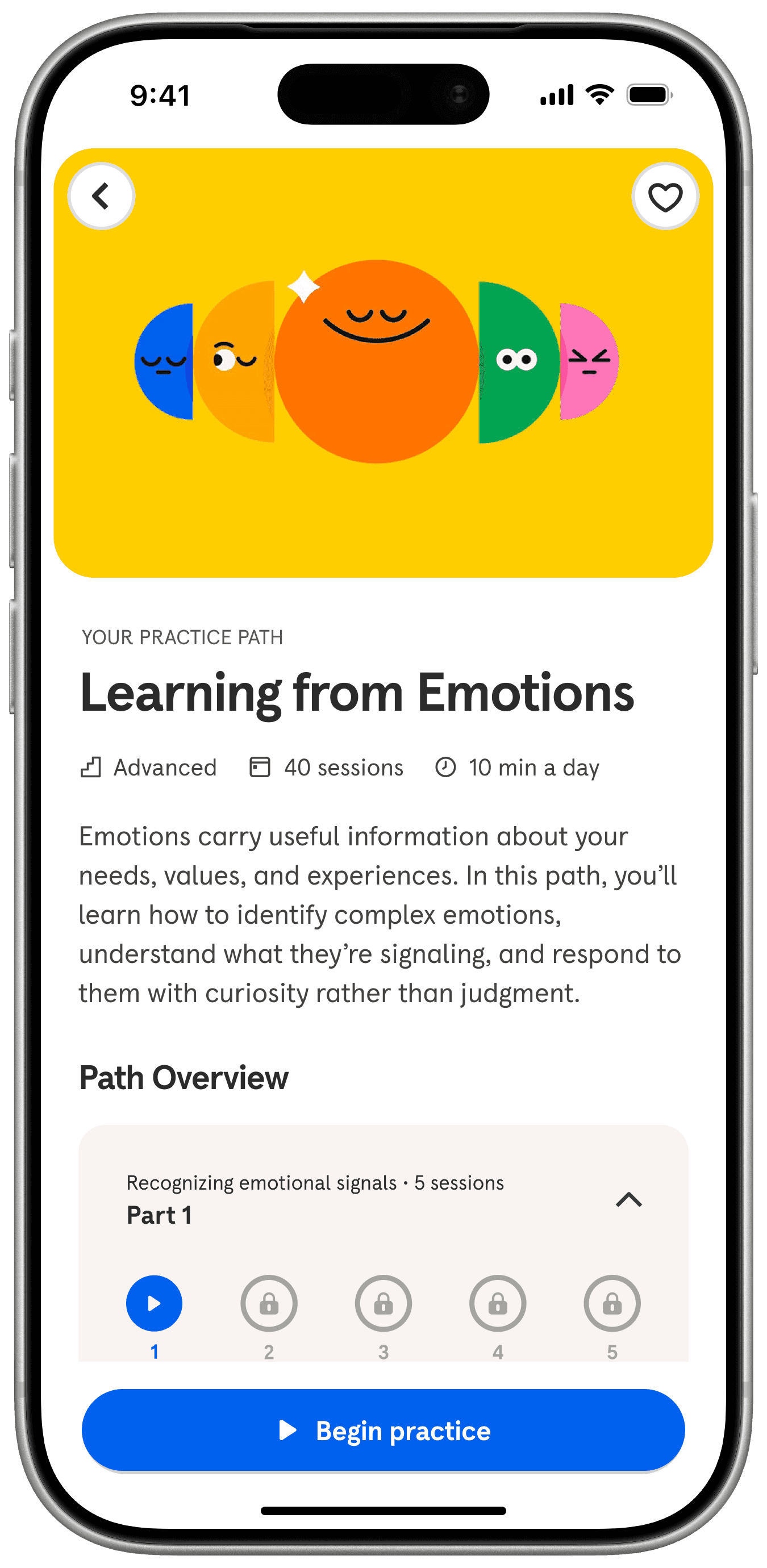
*Screens use structure of existing Headspace programs; I changed content to reflect Practice Paths
*Screens use structure of existing Headspace programs; I changed content to reflect Practice Paths
Supporting long-term skill development through 3 core principles
Supporting long-term skill development through 3 core principles
From awareness to application
From awareness to application
Concepts move beyond recognition into practice, supporting long-term behavior change.
Concepts move beyond recognition into practice, supporting long-term behavior change.
Visible growth noticed over time
Visible growth noticed over time
Progress becomes tangible, supporting habit formation and providing a real sense of improvement.
Progress becomes tangible, supporting habit formation and providing a real sense of improvement.
Thoughtfully
sequenced skills
Thoughtfully sequenced skills
Thoughtfully
sequenced skills
Lessons build upon each other, making new skills easier to apply and reinforcing confidence.
Lessons build upon each other, making new skills easier to apply and reinforcing confidence.
Practice Paths make progress structured, visible, and consistent
Practice Paths make progress structured, visible, and consistent
Interactive lessons like on-the-go quizzes, role-play scenarios, and thought exercises encourage engagement that goes deeper than passive consumption.
Interactive lessons like on-the-go quizzes, role-play scenarios, and thought exercises encourage engagement that goes deeper than passive consumption.
QUIZ
Recognizing cognitive distortions through active reasoning
Recognizing cognitive distortions through active reasoning
1
1
Short exercises fit into daily life while still requiring active thinking
Short exercises fit into daily life while still requiring active thinking
2
2
Immediate feedback reinforces learning in the moment
Immediate feedback reinforces learning in the moment
3
3
Repeated pattern recognition makes distortions easier to spot in real life
Repeated pattern recognition makes distortions easier to spot in real life
ROLE-PLAY
Reframing cognitive distortions in real-life situations
Reframing cognitive distortions in real-life situations
1
1
Cognitive reframing is introduced through familiar relational contexts
Cognitive reframing is introduced through familiar relational contexts
2
2
Compassion is practiced outward, then applied inward
Compassion is practiced outward, then applied inward
3
3
Reflection supports follow-through beyond the app
Reflection supports follow-through beyond the app
GUIDED APPROACH
Extending guidance through gentle nudges
Extending guidance through gentle nudges
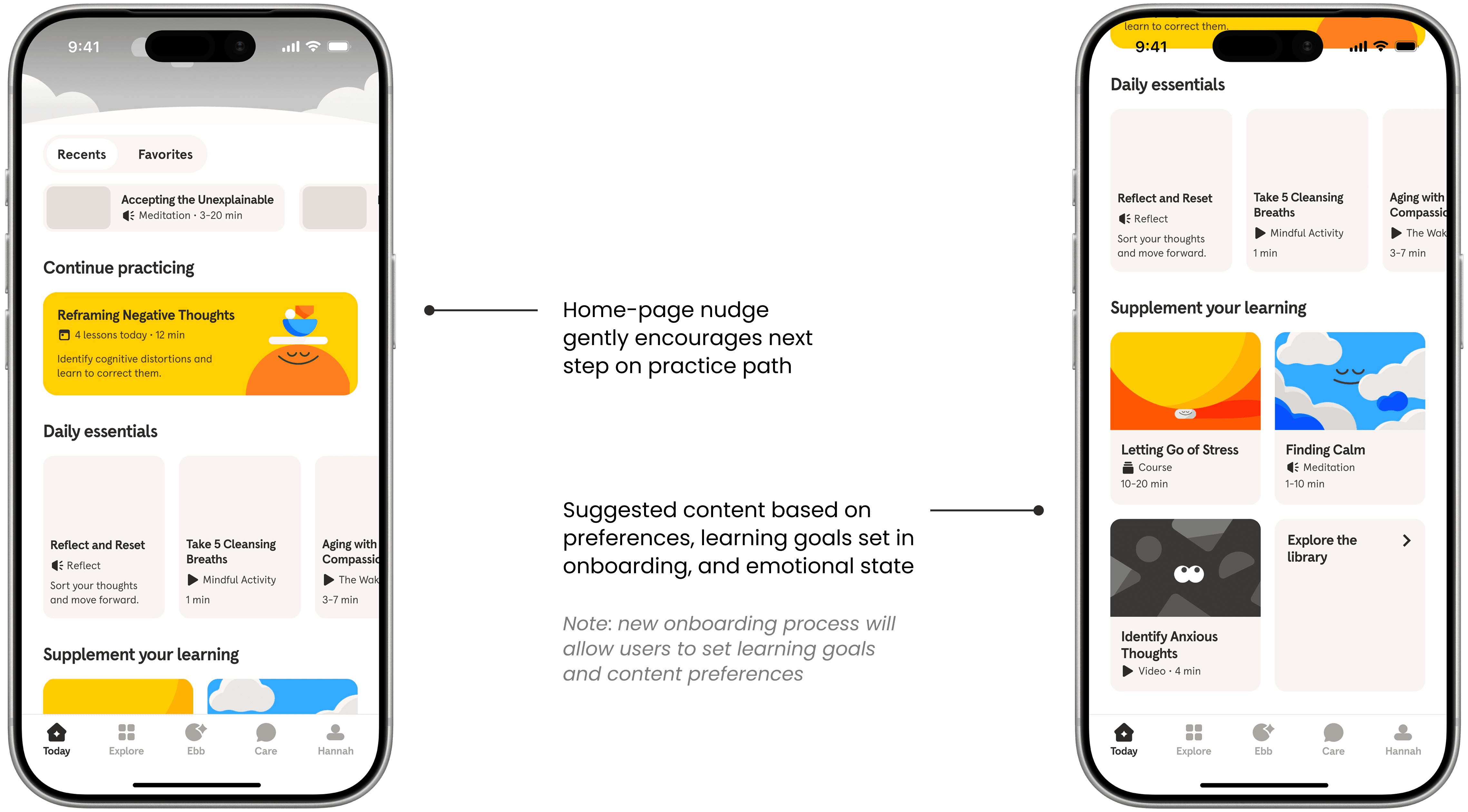
A member's Practice Path is surfaced on the home page to encourage consistent progress. Gentle nudges across the app support a member's learning goals, supplementing their Practice Path with related concepts and guided skill-building.
A member's Practice Path is surfaced on the home page to encourage consistent progress. Gentle nudges across the app support a member's learning goals, supplementing their Practice Path with related concepts and guided skill-building.
HOME PAGE
HOME PAGE
EXPLORE PAGE
EXPLORE PAGE
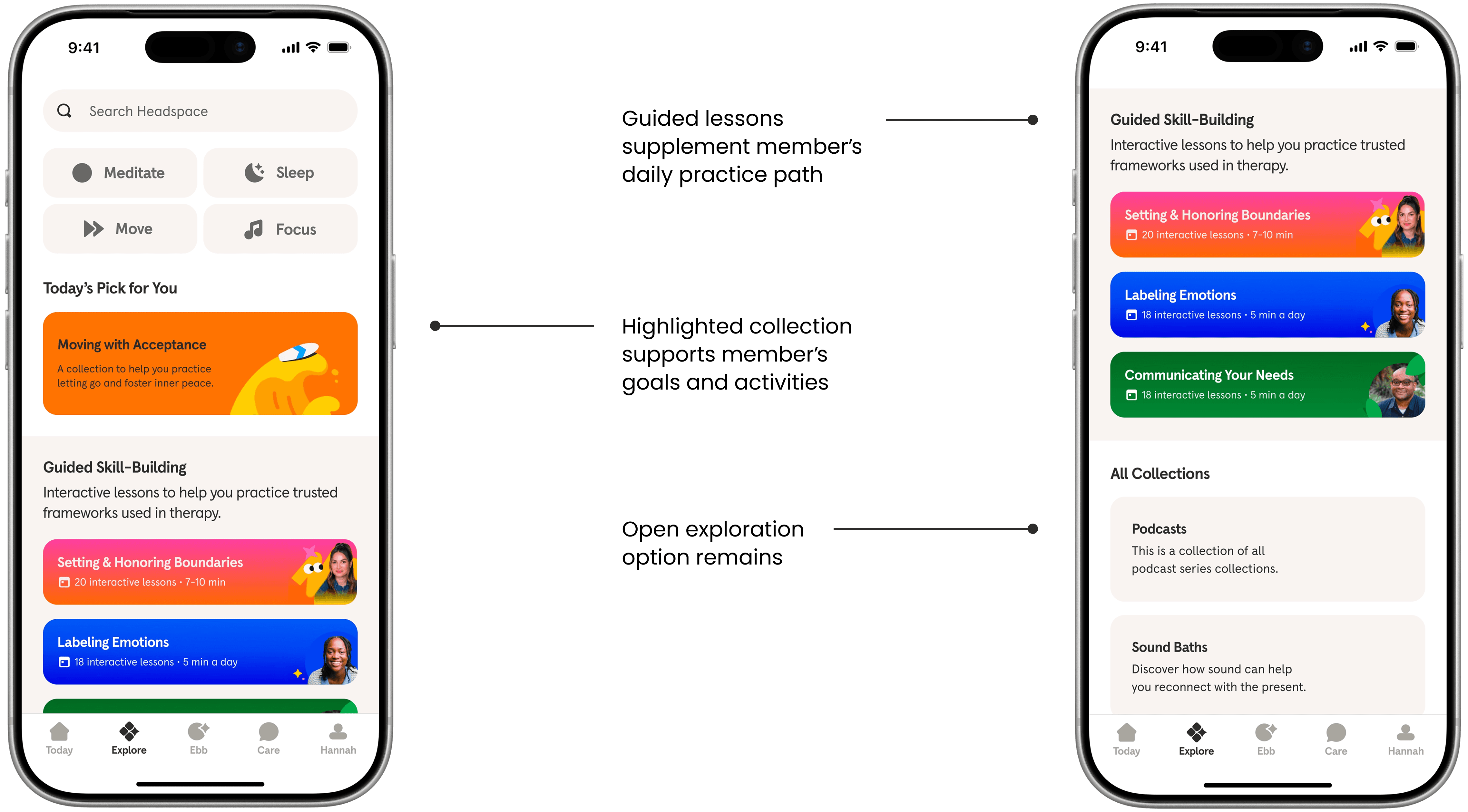
*Changes shown in color; existing app elements in grayscale
*Changes shown in color; existing app elements in grayscale
EMPATHETIC DESIGN
Sensitive design lives in the details
I recognize that mental health is an innately sensitive topic, and Headspace is trusted to support members in their journey. I designed with this brand promise in mind, creating moments of joy and support through small, thoughtful UI elements and language choices.
EMPATHETIC DESIGN
Sensitive design lives in the details
I recognize that mental health is an innately sensitive topic, and Headspace is trusted to support members in their journey. I designed with this brand promise in mind, creating moments of joy and support through small, thoughtful UI elements and language choices.
EMPATHETIC DESIGN
Sensitive design lives in the details
I recognize that mental health is an innately sensitive topic, and Headspace is trusted to support members in their journey. I designed with this brand promise in mind, creating moments of joy and support through small, thoughtful UI elements and language choices.
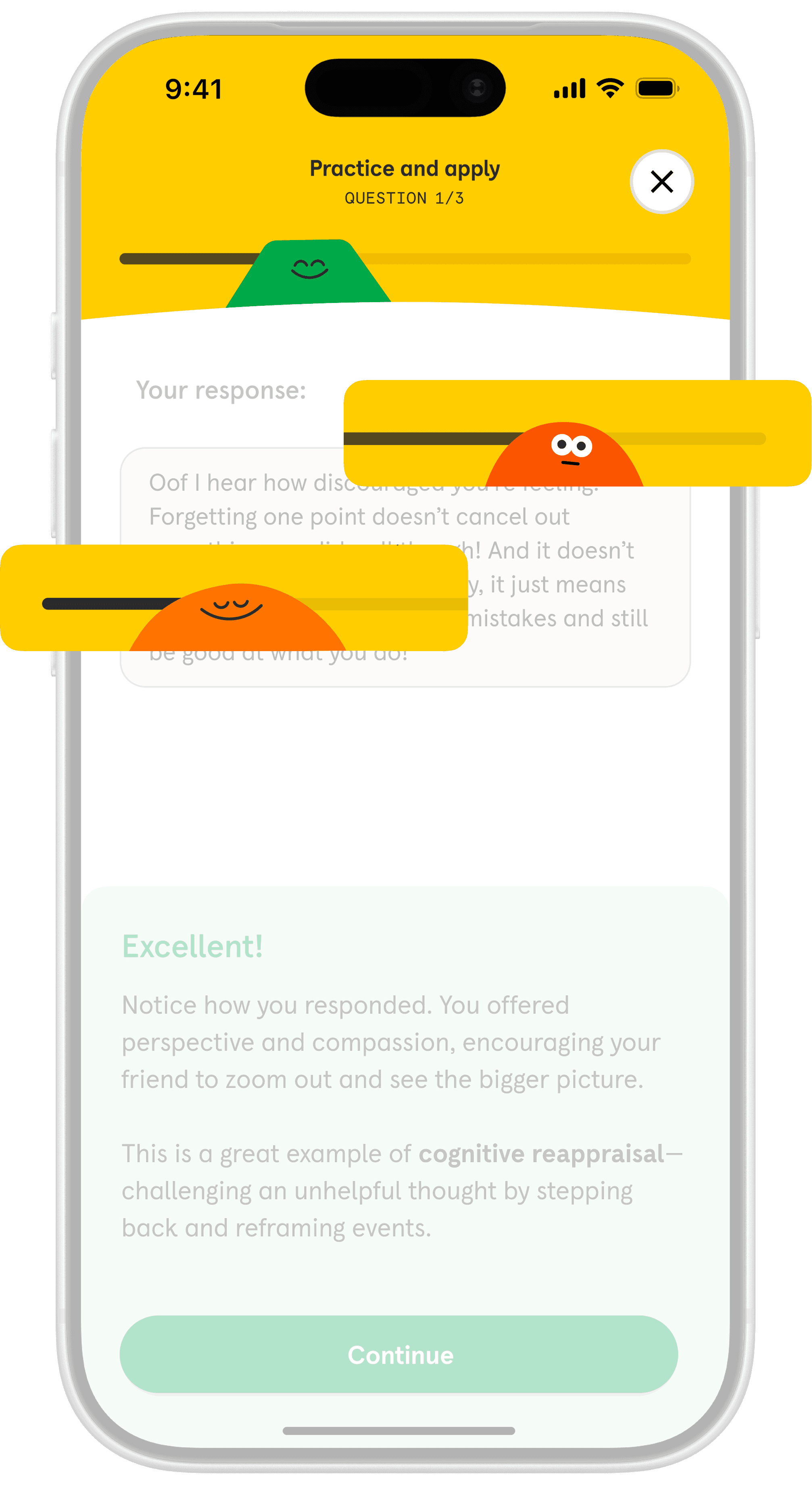
1
Character expressions to reinforce a supportive learning tone
Familiar Headspace faces integrated into the progress bar make skill-building feel warm and human rather than evaluative. Expressions adapt to responses, celebrating correct answers and responding to mistakes with empathy rather than correction.
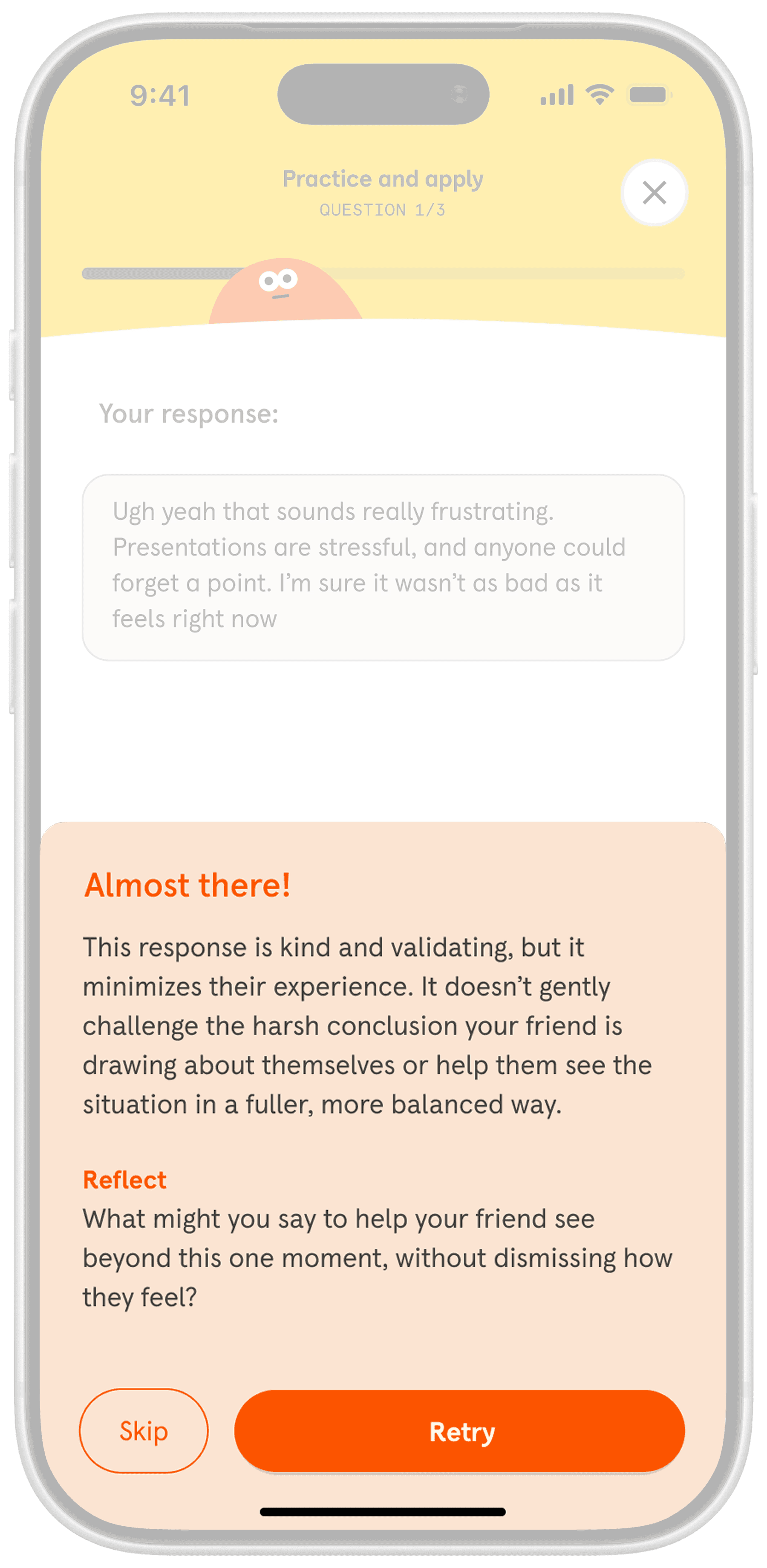
2
Language that encourages resilience, not perfection
Incorrect answers are met with gentle feedback to emphasize growth, not perfection, as the goal. Explanations reinforce reasoning and support knowledge retention.
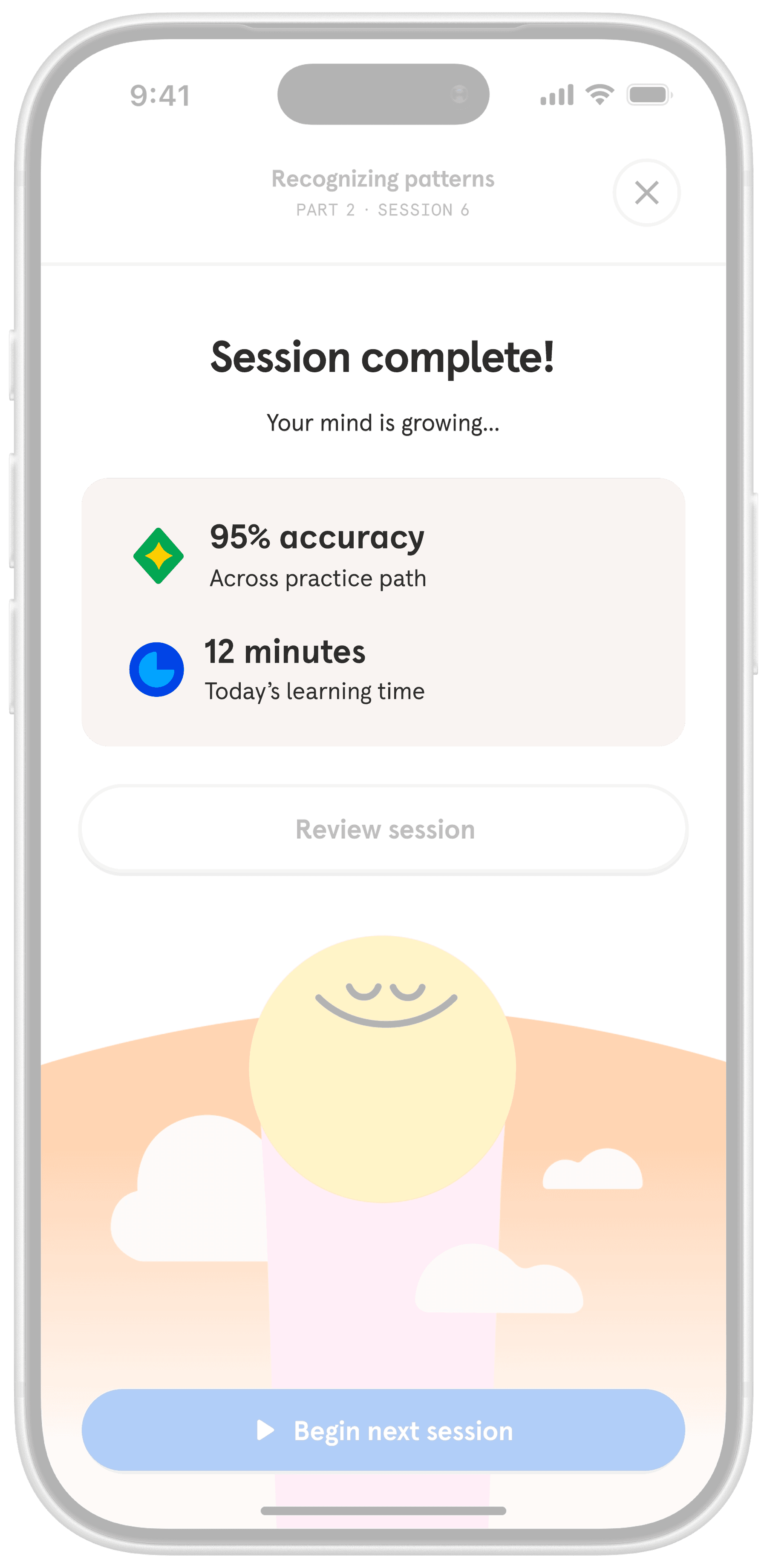
3
Progress framed as growth, not performance
Session results emphasize long-term development rather than one-time accuracy. Members see their overall Practice Path progress alongside time spent learning today, shifting focus from "getting it right" to sustained growth over time.
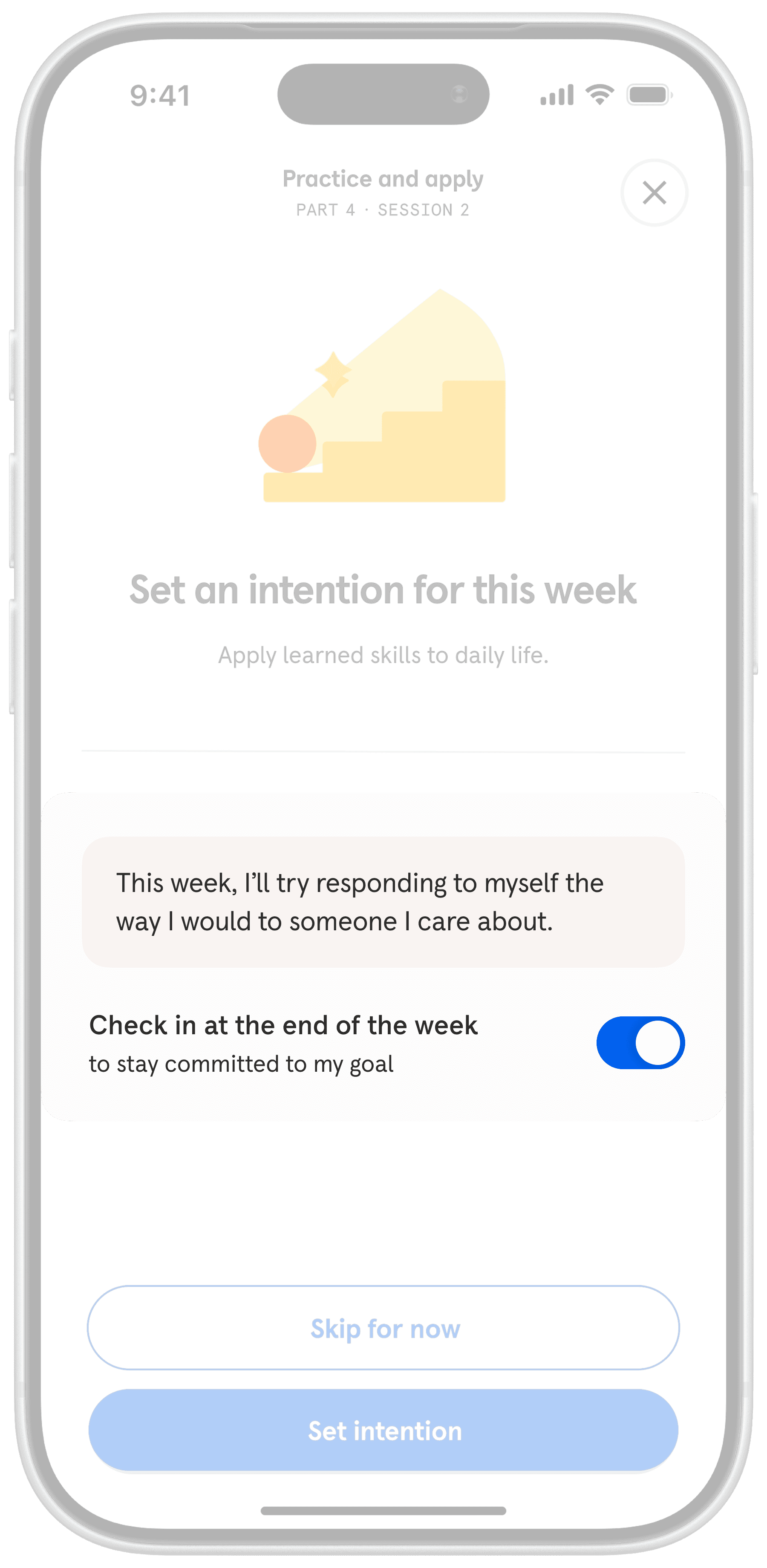
4
Intention-setting to support real-world habit formation
At the end of a session, members may be prompted to set a small, specific intention for applying a skill during their day. This bridges in-app learning with real-life practice and encourages follow-through beyond the app.
5
Moments of delight that reinforce a growth mindset
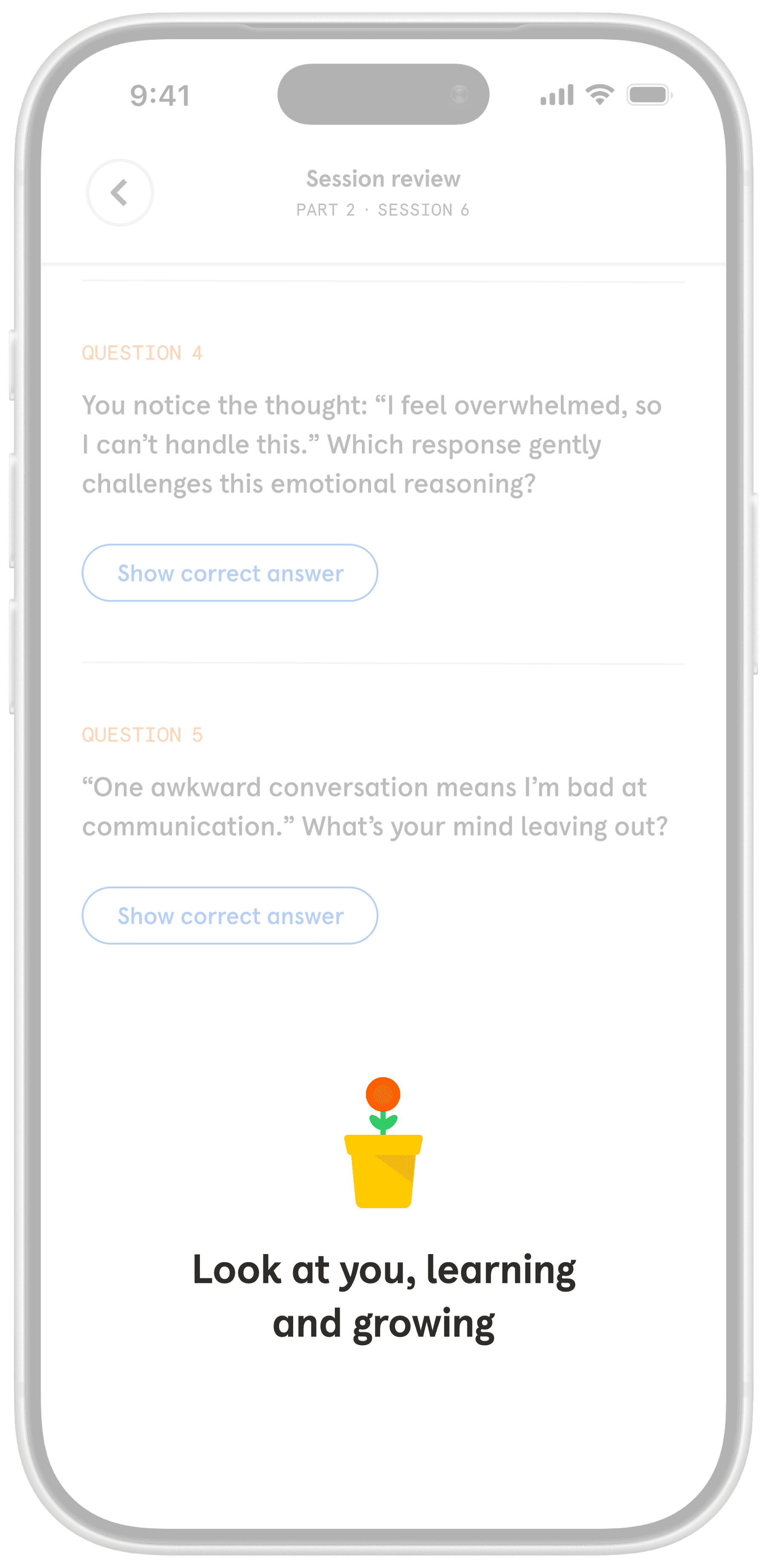
At the end of a session review, an affirming message creates a moment of delight and reminds that growth is gradual and ongoing.
1
Character expressions to reinforce a supportive learning tone
Familiar Headspace faces integrated into the progress bar make skill-building feel warm and human rather than evaluative. Expressions adapt to responses, celebrating correct answers and responding to mistakes with empathy rather than correction.
2
Language that encourages resilience, not perfection
Incorrect answers are met with gentle feedback to emphasize growth, not perfection, as the goal. Explanations reinforce reasoning and support knowledge retention.
3
Progress framed as growth, not performance
Session results emphasize long-term development rather than one-time accuracy. Members see their overall Practice Path progress alongside time spent learning today, shifting focus from "getting it right" to sustained growth over time.
4
Intention-setting to support real-world habit formation
At the end of a session, members may be prompted to set a small, specific intention for applying a skill during their day. This bridges in-app learning with real-life practice and encourages follow-through beyond the app.
5
Moments of delight that reinforce a growth mindset
At the end of a session review, an affirming message creates a moment of delight and reminds that growth is gradual and ongoing.
1
Character expressions to reinforce a supportive learning tone
Familiar Headspace faces integrated into the progress bar make skill-building feel warm and human rather than evaluative. Expressions adapt to responses, celebrating correct answers and responding to mistakes with empathy rather than correction.
2
Language that encourages resilience, not perfection
Incorrect answers are met with gentle feedback to emphasize growth, not perfection, as the goal. Explanations reinforce reasoning and support knowledge retention.
3
Progress framed as growth, not performance
Session results emphasize long-term development rather than one-time accuracy. Members see their overall Practice Path progress alongside time spent learning today, shifting focus from "getting it right" to sustained growth over time.
4
Intention-setting to support real-world habit formation
At the end of a session, members may be prompted to set a small, specific intention for applying a skill during their day. This bridges in-app learning with real-life practice and encourages follow-through beyond the app.
5
Moments of delight that reinforce a growth mindset
At the end of a session review, an affirming message creates a moment of delight and reminds that growth is gradual and ongoing.
1
Character expressions to reinforce a supportive learning tone
Familiar Headspace faces integrated into the progress bar make skill-building feel warm and human rather than evaluative. Expressions adapt to responses, celebrating correct answers and responding to mistakes with empathy rather than correction.
2
Language that encourages resilience, not perfection
Incorrect answers are met with gentle feedback to emphasize growth, not perfection, as the goal. Explanations reinforce reasoning and support knowledge retention.
3
Progress framed as growth, not performance
Session results emphasize long-term development rather than one-time accuracy. Members see their overall Practice Path progress alongside time spent learning today, shifting focus from "getting it right" to sustained growth over time.
4
Intention-setting to support real-world habit formation
At the end of a session, members may be prompted to set a small, specific intention for applying a skill during their day. This bridges in-app learning with real-life practice and encourages follow-through beyond the app.
5
Moments of delight that reinforce a growth mindset
At the end of a session review, an affirming message creates a moment of delight and reminds that growth is gradual and ongoing.
1
Character expressions to reinforce a supportive learning tone
Familiar Headspace faces integrated into the progress bar make skill-building feel warm and human rather than evaluative. Expressions adapt to responses, celebrating correct answers and responding to mistakes with empathy rather than correction.
2
Language that encourages resilience, not perfection
Incorrect answers are met with gentle feedback to emphasize growth, not perfection, as the goal. Explanations reinforce reasoning and support knowledge retention.
3
Progress framed as growth, not performance
Session results emphasize long-term development rather than one-time accuracy. Members see their overall Practice Path progress alongside time spent learning today, shifting focus from "getting it right" to sustained growth over time.
4
Intention-setting to support real-world habit formation
At the end of a session, members may be prompted to set a small, specific intention for applying a skill during their day. This bridges in-app learning with real-life practice and encourages follow-through beyond the app.
5
Moments of delight that reinforce a growth mindset
At the end of a session review, an affirming message creates a moment of delight and reminds that growth is gradual and ongoing.
1
Character expressions to reinforce a supportive learning tone
Familiar Headspace faces integrated into the progress bar make skill-building feel warm and human rather than evaluative. Expressions adapt to responses, celebrating correct answers and responding to mistakes with empathy rather than correction.
2
Language that encourages resilience, not perfection
Incorrect answers are met with gentle feedback to emphasize growth, not perfection, as the goal. Explanations reinforce reasoning and support knowledge retention.
3
Progress framed as growth, not performance
Session results emphasize long-term development rather than one-time accuracy. Members see their overall Practice Path progress alongside time spent learning today, shifting focus from "getting it right" to sustained growth over time.
4
Intention-setting to support real-world habit formation
At the end of a session, members may be prompted to set a small, specific intention for applying a skill during their day. This bridges in-app learning with real-life practice and encourages follow-through beyond the app.
5
Moments of delight that reinforce a growth mindset
At the end of a session review, an affirming message creates a moment of delight and reminds that growth is gradual and ongoing.
1
Character expressions to reinforce a supportive learning tone
Familiar Headspace faces integrated into the progress bar make skill-building feel warm and human rather than evaluative. Expressions adapt to responses, celebrating correct answers and responding to mistakes with empathy rather than correction.
2
Language that encourages resilience, not perfection
Incorrect answers are met with gentle feedback to emphasize growth, not perfection, as the goal. Explanations reinforce reasoning and support knowledge retention.
3
Progress framed as growth, not performance
Session results emphasize long-term development rather than one-time accuracy. Members see their overall Practice Path progress alongside time spent learning today, shifting focus from "getting it right" to sustained growth over time.
4
Intention-setting to support real-world habit formation
At the end of a session, members may be prompted to set a small, specific intention for applying a skill during their day. This bridges in-app learning with real-life practice and encourages follow-through beyond the app.
5
Moments of delight that reinforce a growth mindset
At the end of a session review, an affirming message creates a moment of delight and reminds that growth is gradual and ongoing.
1
Character expressions to reinforce a supportive learning tone
Familiar Headspace faces integrated into the progress bar make skill-building feel warm and human rather than evaluative. Expressions adapt to responses, celebrating correct answers and responding to mistakes with empathy rather than correction.
2
Language that encourages resilience, not perfection
Incorrect answers are met with gentle feedback to emphasize growth, not perfection, as the goal. Explanations reinforce reasoning and support knowledge retention.
3
Progress framed as growth, not performance
Session results emphasize long-term development rather than one-time accuracy. Members see their overall Practice Path progress alongside time spent learning today, shifting focus from "getting it right" to sustained growth over time.
4
Intention-setting to support real-world habit formation
At the end of a session, members may be prompted to set a small, specific intention for applying a skill during their day. This bridges in-app learning with real-life practice and encourages follow-through beyond the app.
5
Moments of delight that reinforce a growth mindset
At the end of a session review, an affirming message creates a moment of delight and reminds that growth is gradual and ongoing.
1
Character expressions to reinforce a supportive learning tone
Familiar Headspace faces integrated into the progress bar make skill-building feel warm and human rather than evaluative. Expressions adapt to responses, celebrating correct answers and responding to mistakes with empathy rather than correction.
2
Language that encourages resilience, not perfection
Incorrect answers are met with gentle feedback to emphasize growth, not perfection, as the goal. Explanations reinforce reasoning and support knowledge retention.
3
Progress framed as growth, not performance
Session results emphasize long-term development rather than one-time accuracy. Members see their overall Practice Path progress alongside time spent learning today, shifting focus from "getting it right" to sustained growth over time.
4
Intention-setting to support real-world habit formation
At the end of a session, members may be prompted to set a small, specific intention for applying a skill during their day. This bridges in-app learning with real-life practice and encourages follow-through beyond the app.
5
Moments of delight that reinforce a growth mindset
At the end of a session review, an affirming message creates a moment of delight and reminds that growth is gradual and ongoing.
1
Character expressions to reinforce a supportive learning tone
Familiar Headspace faces integrated into the progress bar make skill-building feel warm and human rather than evaluative. Expressions adapt to responses, celebrating correct answers and responding to mistakes with empathy rather than correction.
2
Language that encourages resilience, not perfection
Incorrect answers are met with gentle feedback to emphasize growth, not perfection, as the goal. Explanations reinforce reasoning and support knowledge retention.
3
Progress framed as growth, not performance
Session results emphasize long-term development rather than one-time accuracy. Members see their overall Practice Path progress alongside time spent learning today, shifting focus from "getting it right" to sustained growth over time.
4
Intention-setting to support real-world habit formation
At the end of a session, members may be prompted to set a small, specific intention for applying a skill during their day. This bridges in-app learning with real-life practice and encourages follow-through beyond the app.
5
Moments of delight that reinforce a growth mindset
At the end of a session review, an affirming message creates a moment of delight and reminds that growth is gradual and ongoing.
1
Character expressions to reinforce a supportive learning tone
Familiar Headspace faces integrated into the progress bar make skill-building feel warm and human rather than evaluative. Expressions adapt to responses, celebrating correct answers and responding to mistakes with empathy rather than correction.
2
Language that encourages resilience, not perfection
Incorrect answers are met with gentle feedback to emphasize growth, not perfection, as the goal. Explanations reinforce reasoning and support knowledge retention.
3
Progress framed as growth, not performance
Session results emphasize long-term development rather than one-time accuracy. Members see their overall Practice Path progress alongside time spent learning today, shifting focus from "getting it right" to sustained growth over time.
4
Intention-setting to support real-world habit formation
At the end of a session, members may be prompted to set a small, specific intention for applying a skill during their day. This bridges in-app learning with real-life practice and encourages follow-through beyond the app.
5
Moments of delight that reinforce a growth mindset
At the end of a session review, an affirming message creates a moment of delight and reminds that growth is gradual and ongoing.
1
Character expressions to reinforce a supportive learning tone
Familiar Headspace faces integrated into the progress bar make skill-building feel warm and human rather than evaluative. Expressions adapt to responses, celebrating correct answers and responding to mistakes with empathy rather than correction.
2
Language that encourages resilience, not perfection
Incorrect answers are met with gentle feedback to emphasize growth, not perfection, as the goal. Explanations reinforce reasoning and support knowledge retention.
3
Progress framed as growth, not performance
Session results emphasize long-term development rather than one-time accuracy. Members see their overall Practice Path progress alongside time spent learning today, shifting focus from "getting it right" to sustained growth over time.
4
Intention-setting to support real-world habit formation
At the end of a session, members may be prompted to set a small, specific intention for applying a skill during their day. This bridges in-app learning with real-life practice and encourages follow-through beyond the app.
5
Moments of delight that reinforce a growth mindset
At the end of a session review, an affirming message creates a moment of delight and reminds that growth is gradual and ongoing.
DESIGNING FOR THE HEADSPACE ECOSYSTEM
Building on Headspace's existing strengths
Building on Headspace's existing strengths
Before introducing new patterns, I studied the app's existing learning flows, content structures, and interaction tone. Practice Paths build on familiar interaction patterns so the experience would feel intuitive for members and feasible for product teams to implement.
Before introducing new patterns, I studied the app's existing learning flows, content structures, and interaction tone. Practice Paths build on familiar interaction patterns so the experience would feel intuitive for members and feasible for product teams to implement.
EXISTING
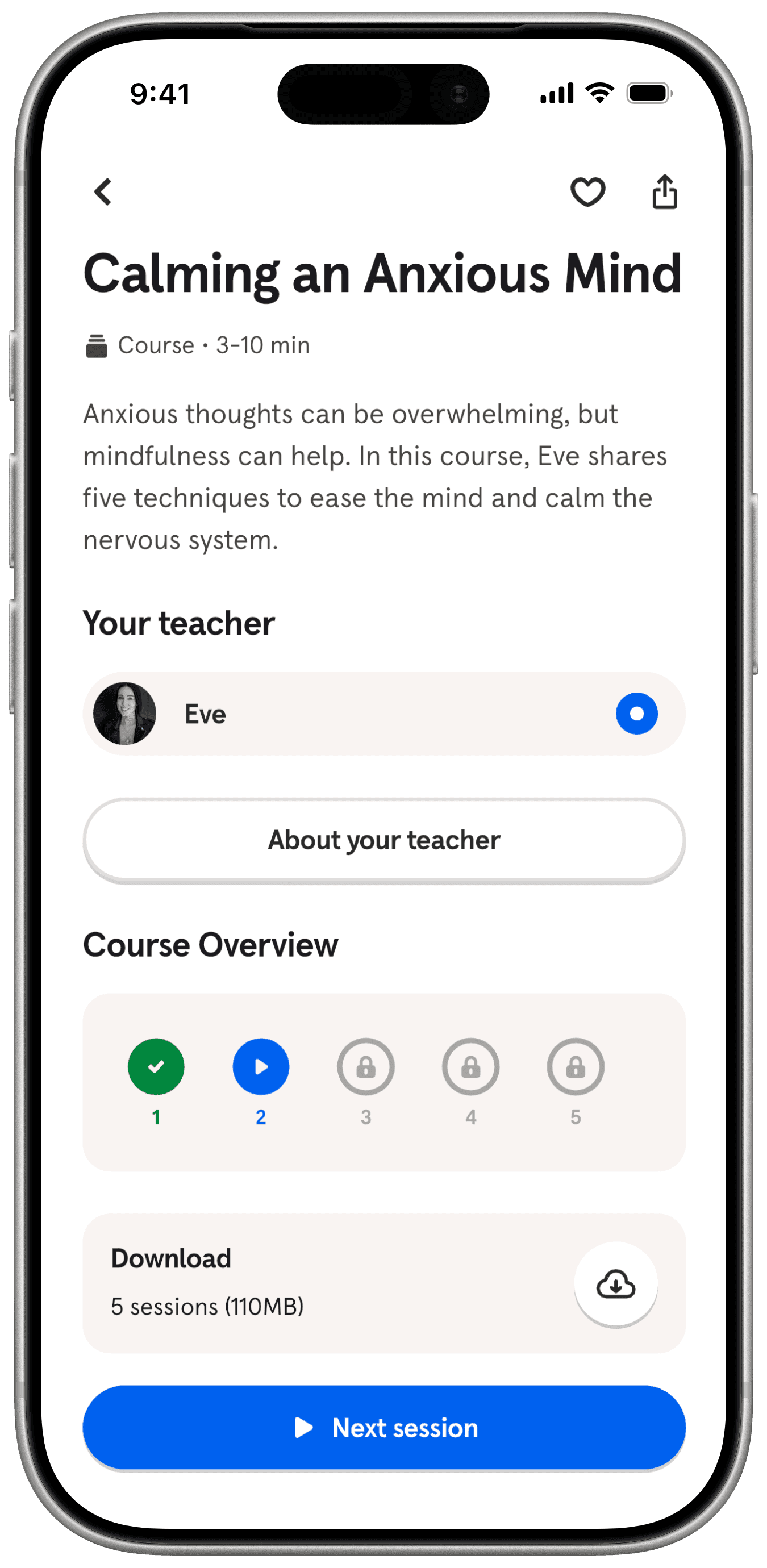
Headspace course overview
EVOLUTION
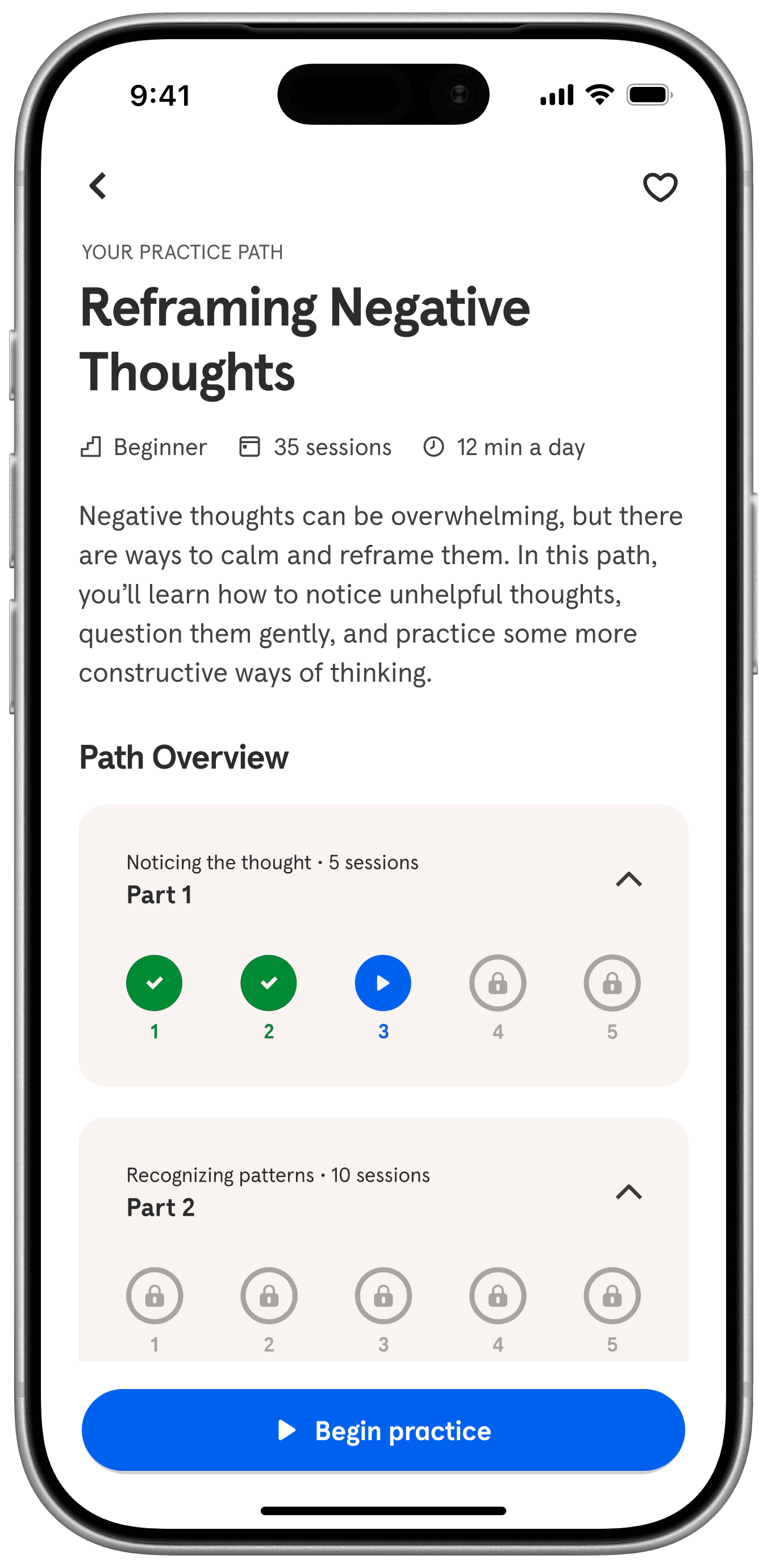
Practice Path overview
Familiar course structure for guided skill-building
Familiar course structure for guided skill-building
Practice Path builds on Headspace’s structured course overview, adapting the familiar format to guide members through skill-building lessons and track their progress.
Practice Path builds on Headspace’s structured course overview, adapting the familiar format to guide members through skill-building lessons and track their progress.
EXISTING
Headspace reflection moment

EVOLUTION
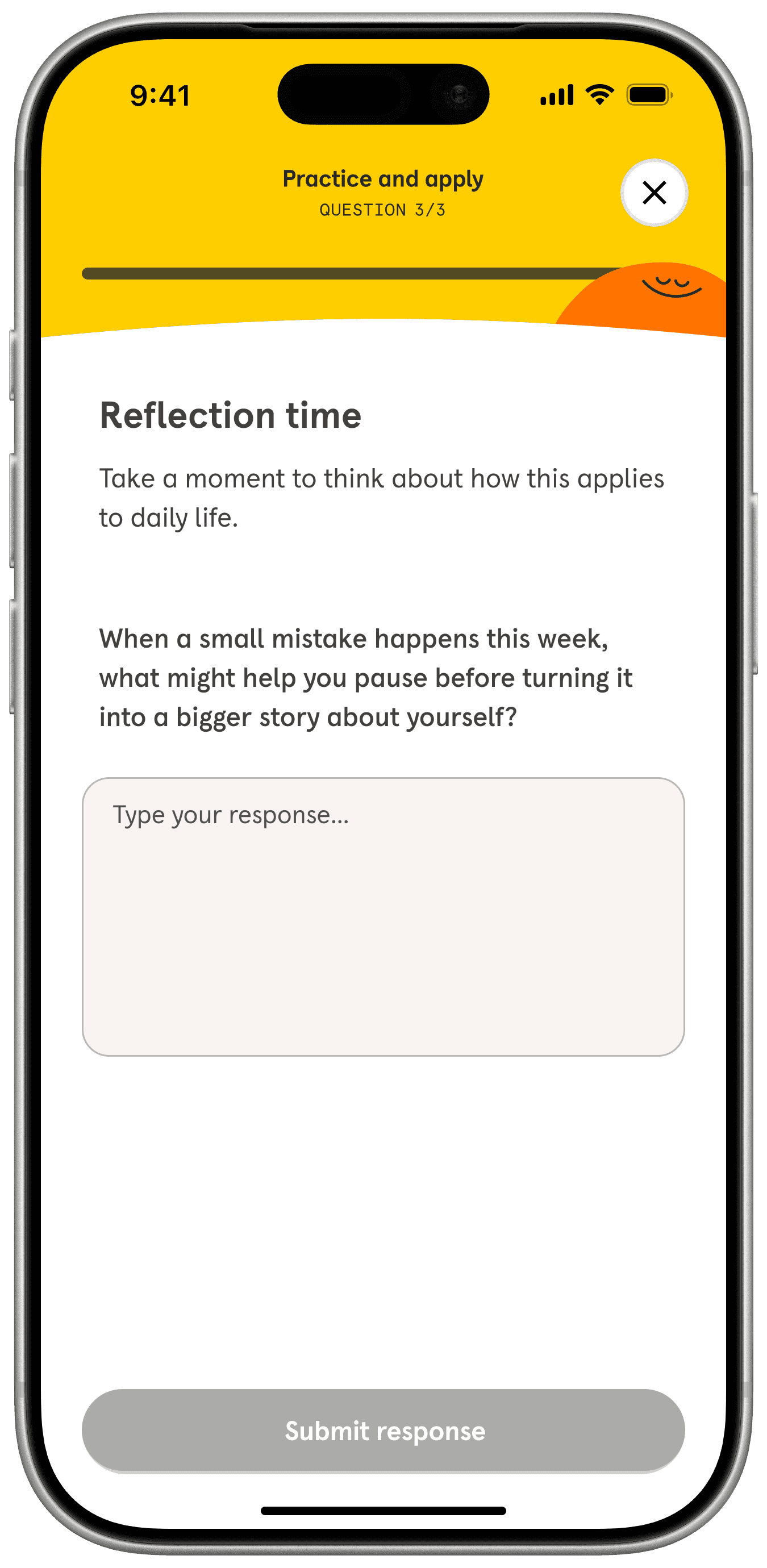
Practice Path reflection question
Reflection prompts that encourage active engagement
Reflection prompts that encourage active engagement
Practice Path expands on moments of reflection in Headspace lessons by introducing concept-based prompts that ask members to write out their thoughts, reinforcing conceptual understanding.
Practice Path expands on moments of reflection in Headspace lessons by introducing concept-based prompts that ask members to write out their thoughts, reinforcing conceptual understanding.
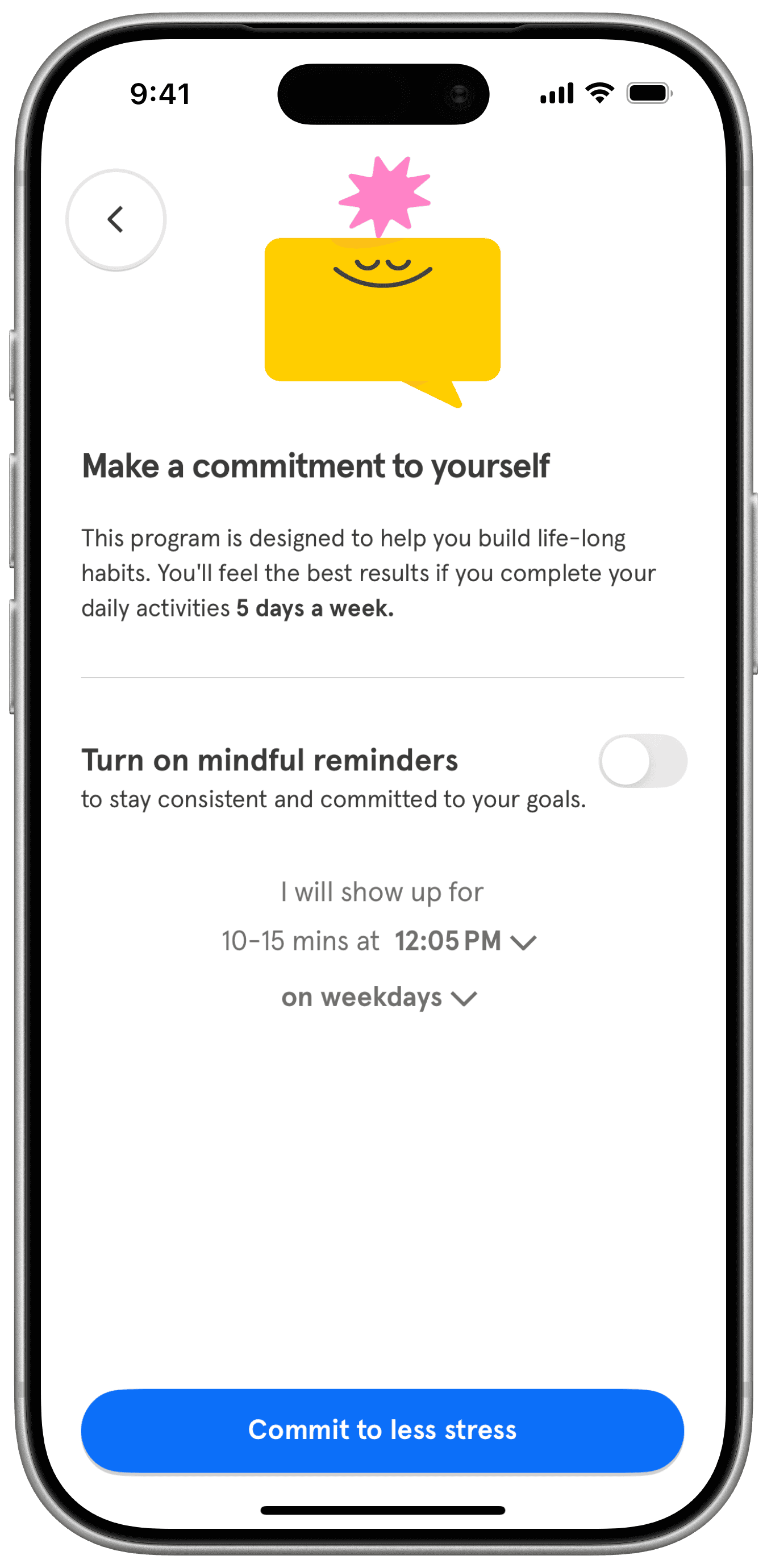
EXISTING
Headspace reminder prompt
EVOLUTION
Practice Path intention prompt
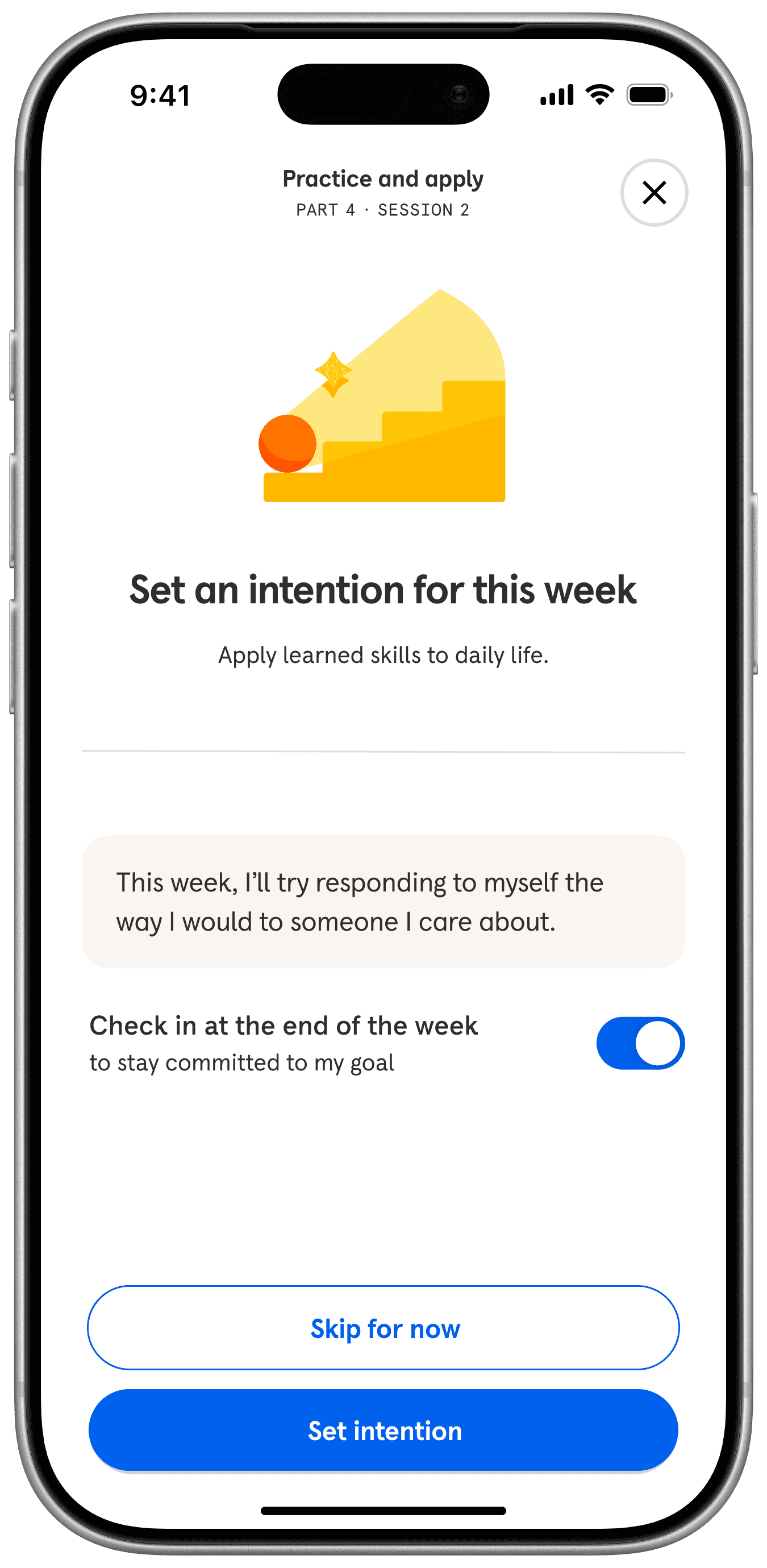
Intention setting that supports real-world practice
Intention setting that supports real-world practice
Headspace encourages habit-building through daily reminders to return to the app. Practice Path extends this by prompting members to set small intentions to apply newly practiced skills in real-life situations.
Headspace encourages habit-building through daily reminders to return to the app. Practice Path extends this by prompting members to set small intentions to apply newly practiced skills in real-life situations.
CONSIDERING TRADE-OFFS
Balancing structure, agency, and emotional tone
Balancing structure, agency, and emotional tone
I considered several trade-offs to shape the design of Practice Paths, ensuring the experience stays empowering, approachable, and aligned with Headspace's voice.
I considered several trade-offs to shape the design of Practice Paths, ensuring the experience stays empowering, approachable, and aligned with Headspace's voice.
Preserving agency within guidance
While paths are guided, members retain flexibility to explore content at their own pace, preventing over-prescription
While paths are guided, members retain flexibility to explore content at their own pace, preventing over-prescription
Balancing cognitive load with depth
Interactive lessons are lightweight, so daily use feels approachable rather than daunting
Interactive lessons are lightweight, so daily use feels approachable rather than daunting
Maintaining a supportive tone
Feedback and prompts are supportive and growth-oriented, avoiding language that feels corrective or evaluative
Feedback and prompts are supportive and growth-oriented, avoiding language that feels corrective or evaluative
POTENTIAL IMPACT
Designing for mental health outcomes at scale
12 foundational skills, all in one place
I considered how an active, guided approach could influence outcomes across individuals, the product itself, and the broader mental health landscape.
Twelve spaces, each with their own learning goals, highlight concepts fundamental to achieving optimal well-being—and along the way, growth, connection, and self-awareness. Featured below are some of the interactive spaces most critical to the purpose of the experience.
For members
For members
1
1
Deeper skill internalization
Learning the right skill at the right time can make it easier for members to apply them in daily life.
Learning the right skill at the right time can make it easier for members to apply them in daily life.
2
2
Reduced cognitive load
When stress or overwhelm are high, fewer options can make it easier to engage.
When stress or overwhelm are high, fewer options can make it easier to engage.
3
3
Increased confidence
Building skills can help members work toward personal goals, providing a sense of improvement beyond consumption of content.
Building skills can help members work toward personal goals, providing a sense of improvement beyond consumption of content.
For Headspace
For Headspace
1
1
Increased member retention
Skill-building can inspire ongoing use by making Headspace integral to personal growth rather than one-off relief.
Skill-building can inspire ongoing use by making Headspace integral to personal growth rather than one-off relief.
2
2
Modeling ethical, care-centered personalization
Gentle guidance sets a precedent for personalization that prioritizes well-being outcomes over engagement alone.
Gentle guidance sets a precedent for personalization that prioritizes well-being outcomes over engagement alone.
3
3
Clearer value differentiation
Active learning can help Headspace stand out from other wellness apps that primarily offer passive consumption.
Active learning can help Headspace stand out from other wellness apps that primarily offer passive consumption.
For society
For society
1
1
Greater emotional skill-building at scale
Active practice helps translate mental health concepts into usable skills, noticed from individual to community levels.
Active practice helps translate mental health concepts into usable skills, noticed from individual to community levels.
2
2
Earlier intervention to reduce harm severity
Equipping people with foundational skills can help to foster well-being before challenges arise.
Equipping people with foundational skills can help to foster well-being before challenges arise.
3
3
Reduced stigma
When mental health skill-building is framed as something everyone practices, it becomes more approachable.
When mental health skill-building is framed as something everyone practices, it becomes more approachable.

Takeaways
Takeaways
Designing within an existing system creates more adoptable solutions.
Mental health tools require trust, which Headspace has, so instead of designing from the ground up, I worked within existing brand and interaction patterns so I could focus on the finer details of the experience. Designing within an existing system challenged me to think about long-term strategy and growth while creating a solution that feels more realistic, adoptable, and aligned with the product's potential evolution.

